

Save water: don't flush to drain
Much of England and all of Wales are in drought.
Prolonged dry weather and sustained high temperatures have led water companies to impose hosepipe bans affecting more than 23 million people - and more are still expected to follow.
River levels have continued to fall. Reservoir levels have dropped below normal.
There has been very little rainfall over the past seven weeks. A persistent weather pattern is creating a domino effect - increasing the likelihood and spread of wildfires, putting pressure on food production, damaging natural habitats and killing wildlife.
So how can it be that, during a water shortage of this scale, companies are still permitted to flush millions of litres of water to drain from HVAC systems?
Particularly when there are alternatives.
And, in our view, flushing to drain isn't just wasteful and environmentally irresponsible - it's an inferior method of cleaning heating and cooling systems.
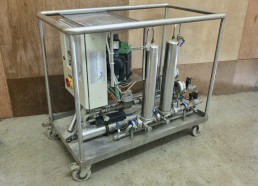
This little rig, pictured, has only ever filled systems. That water then remains in the system and nothing is flushed to drain.
This little rig has treated more than 1,106 m³ of water.
This little rig is so effective that it has avoided 30-50 times that volume being needlessly flushed to drain - roughly 33-55,000,000 litres of water. At even the lower end of the saving that's:
- Enough to fill around 13 Olympic-sized swimming pools
- Enough to provide approximately 80mm of irrigation across 1,000 acres of dry farmland
- Enough domestic water for around 650 people for a year
And that's just one rig.
We have many more: 45 in total in fact, of varied sizes.
So, during a drought crisis, we have to ask: Is flushing millions of litres of water to drain really acceptable when it can be avoided?
Not in our view.

Tackling raised copper levels
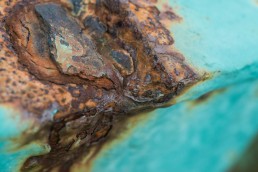
Noticing elevated copper levels in your water system? This is a common problem we come across...
If you’re carrying out a CPC clean (as we recommend) and not flushing the system to drain, you may occasionally see raised copper levels. This is usually linked to poor installation practices - particularly an excess or incorrect use of flux.
There’s an approved method, highlighted in BG 29 (2020), the BSRIA guide on Pre-Commission Cleaning, known as the WRAS-Approved Installation Method (AIM) that outlines the correct approach and points out that it is important to avoid excessive use of flux.
Whatever the cause, Hydrosphere provides a free test on water samples to confirm whether our specialist equipment to remove copper is the correct solution for your setup.
Let’s keep systems clean, efficient, and compliant.
Get in touch at +44 (0) 1580 211311 / info@hydrosphere-uk.com to find out more.

Army of new vessels and units arrives
We’ve recently taken delivery of nine shiny new 75-litre resin vessels as well as a dozen more 4-inch Hydrosphere Conditioning Units (HCUs) that will each take 10 filters at a time.
Our stainless-steel housings ensure microbiological contaminants and corroded materials are not introduced back into the system during cleaning; and their capacity makes them configurable for bigger projects such as district heating networks and data centres.
Meanwhile our resin vessels are perfect for filling new systems with demineralised water, which prevents corrosion and eliminates the need for chemicals, as well as addressing issues in current systems, such as the presence of copper and iron.
After a final few in-house modifications these will all be site-fit and ready for your jobs.
Network Solution achieves double milestone
Hydrosphere has achieved two major milestones in the development of its groundbreaking Network Solution (NS5), marking an important step forward for pre-commission and remedial cleaning of large-scale closed-loop heating networks.
Following almost two years of research, development and testing, the company has submitted a UK patent application (GB Patent Applied For: GB2614990.6) for the innovative system, and it has also now begun its first live deployment on a major district heating project.
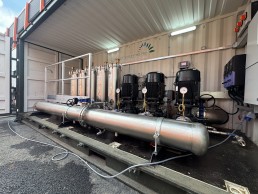
The container-sized Network Solution is a fully automated pre-commission and remedial cleaning system, designed to carry out Hydrosphere's Closed-loop Pre-treatment Cleaning (CPC) process on large-scale heating networks. Developed to simplify commissioning while providing unprecedented levels of monitoring and control, the system represents a significant advancement in district energy technology.
The first installation saw the Hydrosphere team support the filling and start of the cleaning of a major district heating network. Using a Hydrosphere filling rig, the network was filled with more than one million litres of water and pressurised to 15 bar before the Network Solution was installed and brought online.
Referred to as the 'NS5' after its five filter housings, the system is now fully operational and providing the commissioning team with live remote monitoring throughout the cleaning process. Real-time data, including system status, filter condition and water conductivity, enables engineers to monitor performance continuously, helping to optimise the commissioning process and identify issues as they arise.
Alongside the Network Solution, Hydrosphere supplied a comprehensive range of supporting equipment for the project, including an IBC, hoses, connectors and two additional inline booster pumps. The cleaning programme is expected to continue for approximately four weeks before the project moves into the next stage of commissioning.
The deployment of the NS5 represents far more than the successful launch of a new product.
"It has taken almost two years to bring the Network Solution from concept to a live project," said Peter Barrett, Founder and Technical Director. "Seeing it operating on its first installation is an incredibly proud moment for everyone involved. Submitting the patent application and deploying the system for the first time are significant milestones that demonstrate both the innovation behind the technology and the market's need for it."
As demand for district heating networks continues to grow, Hydrosphere believes the Network Solution will help improve commissioning efficiency, reduce downtime and provide clients with greater visibility throughout the cleaning process.
The first deployment is just the beginning. The company looks forward to supporting further projects and continuing to demonstrate the benefits of automated, remotely monitored cleaning for large-scale energy infrastructure.
Putting UV to work
The UK is in the midst of an historic heatwave and it's not alone. Temperatures across Spain, Switzerland, France, Germany and northern Italy have been 10-15C above average for late May and it's likely more records will be broken before the week is out.
Not only is the mercury rising, UV rates caused by radiation from the sun are also high, and while too much UV may be bad for the skin it has multiple beneficial applications across industry, medical treatments, forensic detection, and, of course, in the production of vitamin D (UV-B).
Another plus is its ability to sterilise and disinfect. UV-C light destroys bacteria, viruses and fungi by damaging their genetic material. It is put to use in air sterilisers, food processing, and to sterilise hospital environments.
It is also used in the purification of water - interfering with bacteria’s DNA by preventing it from reproducing and essentially spoiling its fun. Cell division stops and bugs are halted in their tracks.
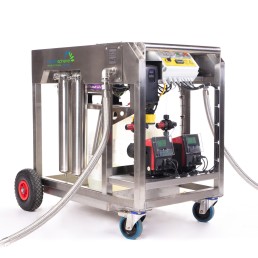
This is why we have a UV chamber on all filling rigs because it incorporates a further layer of protection into pre-commission fills. It is part of a line of defences that also includes a pre-filter media that quickly captures much of any big nasties; then a BioBlock - a medical grade, sub-micron filter that prevents bacteria entering the system; followed by precision dosing of chemicals.
We do this because we know that water that is filled and treated correctly from the start means networks can operate efficiently and effectively, free from bugs and corrosive elements that would otherwise degrade the pipes and the system water within them.
The invention that set a new standard
This week marks 14 years since a very proud moment in my career: The official granting of a patent for a process I invented that has changed the face of an industry: Hydrosphere (also now known as ‘CPC’).
It’s no small thing to achieve a patent. It’s not just about having a good idea, it has to be something novel, and non-obvious (i.e. more than just a small tweak to something already out there) and capable of industrial application, and Hydrosphere achieved all three.
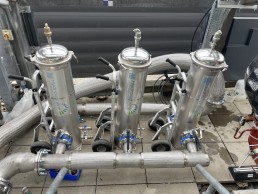
It comprises two concepts: HydroFill and HydroClean, which, when combined, work symbiotically to produce superior quality system water and long-lasting protection of brand new installations.
HydroFill means all the systems are pre-treated using our (also) patented pre-treatment equipment which prevents almost 100% of microbial life from entering a system. It protects and passivates new systems, from the first drop of water to the last.
HydroClean is the second part of the process - the conditioning equipment (HCUs) enables us to clean systems at BSRIA-specified velocity by removing all system debris through highly efficient cartridge media. All this whilst discharging no water to drain and completing projects in less time than all other methods for pre-commission cleaning systems.
The introduction of this closed-loop cleaning process (CPC) has marked a fundamental shift. Until Hydrosphere was invented, every water treatment company was flushing systems in an antiquated and archaic fashion. This meant throwing millions of litres of chemical effluent down the drain and spending an unnecessary amount of time on-site and causing long-term damage to pipework installations. Sadly some still do, which is odd because the benefits are hard to ignore:
1. Significant water savings
Closed-loop cleaning reduces overall water consumption compared with flushing to drain.
2. Smarter chemical use
Precise dosing and continuous monitoring mean minimal chemical usage and more effective cleaning outcomes.
3. Reduced environmental impact
No effluent is flushed to drain, which eliminates pollution and helps companies to meet stricter compliance requirements.
4. Improved system efficiency
This way of filling and cleaning systems is more effective; produces better and more reliable results; and delivers operational efficiently.
5. Safer operations
A contained process (the HydroFill rig) reduces operator exposure to chemicals and improves overall site safety.
As regulations tighten and sustainability targets become more demanding, approaches like CPC are becoming essential; and Hydrosphere licensed water treatment companies are also able to clean systems far quicker than other pre-commission cleaning methods - so, why would you do anything else?

The power of a reverse return
"Stop checking every filter individually: Design it out instead," says Hydrosphere's Technical Director and Founder Peter Barrett.
"If you’re running filters in parallel in a CPC clean and fail to configure it well, inconsistent flow will be your hidden enemy. Water takes the path of least resistance - it’s lazy. A poor set up will result in some filter units getting too much flow while others get very little.
"This results in the filter set up being out of balance, pumps not being able to work as efficiently as they should, and you - or your team - will need to keep checking filters individually housing by housing."
There’s a better way, he says, a reverse return arrangement.
Configuring it this way means:
- First in = last in
- Equal pipe lengths
- A naturally balanced flow
In practice this means:
- Every filter gets the same flow
- There are no ‘weak performers’ at the end of the line
- And, no need to rebalance the system
And most importantly…
- You can change all the filters in each housing in one go - saving you time, effort and money.
Reverse return is smart engineering.

Why we love a system layout
The Hydrosphere team relishes pouring over the schematics of water treatment systems and getting into the details.
Every pipe run, valve, bypass, pump, and connection point on a drawing tells a story. By carefully reviewing system layouts, we can pinpoint precisely what equipment is needed to fill and/or clean the pipework on projects; as well as proposing where it is connected; and approximately how long a project will take.
We understand acutely how expensive time and staffing costs are, so our focus is always on making sure that projects are delivered as efficiently as possible.
We can also advise as to whether you may need other supplementary kit, such as our deaerator (which does just what it sounds like it does).
We take a collaborative approach, acting in concert with our clients to share how we would do it and providing them with suggestions they may not have thought of.
It’s never just about hiring equipment - it’s about understanding the process, minimising risk, and making sure the solution fits the system, not the other way around.
Give us a set of drawings and a challenge, and we’re in our element.
5 reasons why CPC beats flushing to drain
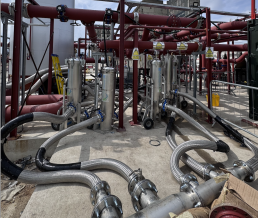
Project and commissioning managers are still often asked to flush to drain by companies who are unaware of the newer and far superior way of cleaning and preparing closed water systems: Hydrosphere's CPC.
So here's five reasons you can give them to make the case for a method that is better for their purse and the planet:
1. Faster & More Cost-Effective
Traditional flushing involves multiple flushes to drain and chemical cycles, and introduces chemical and microbiological uncertainty. Hydrosphere’s CPC process uses pre-treated water, and systems are cleaned through high-efficiency filtration. This reduces the number of stages involved and means projects are completed 50% faster, labour costs are halved and certainty is delivered.
2. No Effluent Licence or Disposal Hassle
Hydrosphere’s process is effluent-free. No contaminated discharge, no licence requirements, and no disposal logistics. This means fewer compliance headaches and lower costs.
3. Better Performance, Longer Lifespan
By conditioning the system correctly from the first fill and removing debris and corrosion by high-flow filtration, Hydrosphere’s process delivers cleaner systems that perform better and last longer. This significantly reduces repair and maintenance costs.
4. Significantly Lower Environmental Impact
Flushing to drain uses up to 30 system volumes of water, which is discharged as chemical effluent. Hydrosphere’s process only uses the water that’s needed to fill the system and completely eliminates polluting discharge. This achieves a major sustainability advantage on all projects.
5. Simpler Set-Up, More Reliable Results
Hydrosphere’s closed-loop method keeps treated water within the system, providing consistent protection while contaminants are filtered. This delivers dependable, standards-compliant results.
If you’re still flushing to drain, it's not just water you're wasting.
Hydrosphere is the most environmentally responsible, easy to use and less damaging replacement for the traditional process of system pre-commission filling and chemical flushing of heating and cooling systems.